The repeater from the previous post now has its INA219. The shunt sits in the battery’s positive lead, with its negative side towards the battery, so it reads negative while discharging and positive while charging.
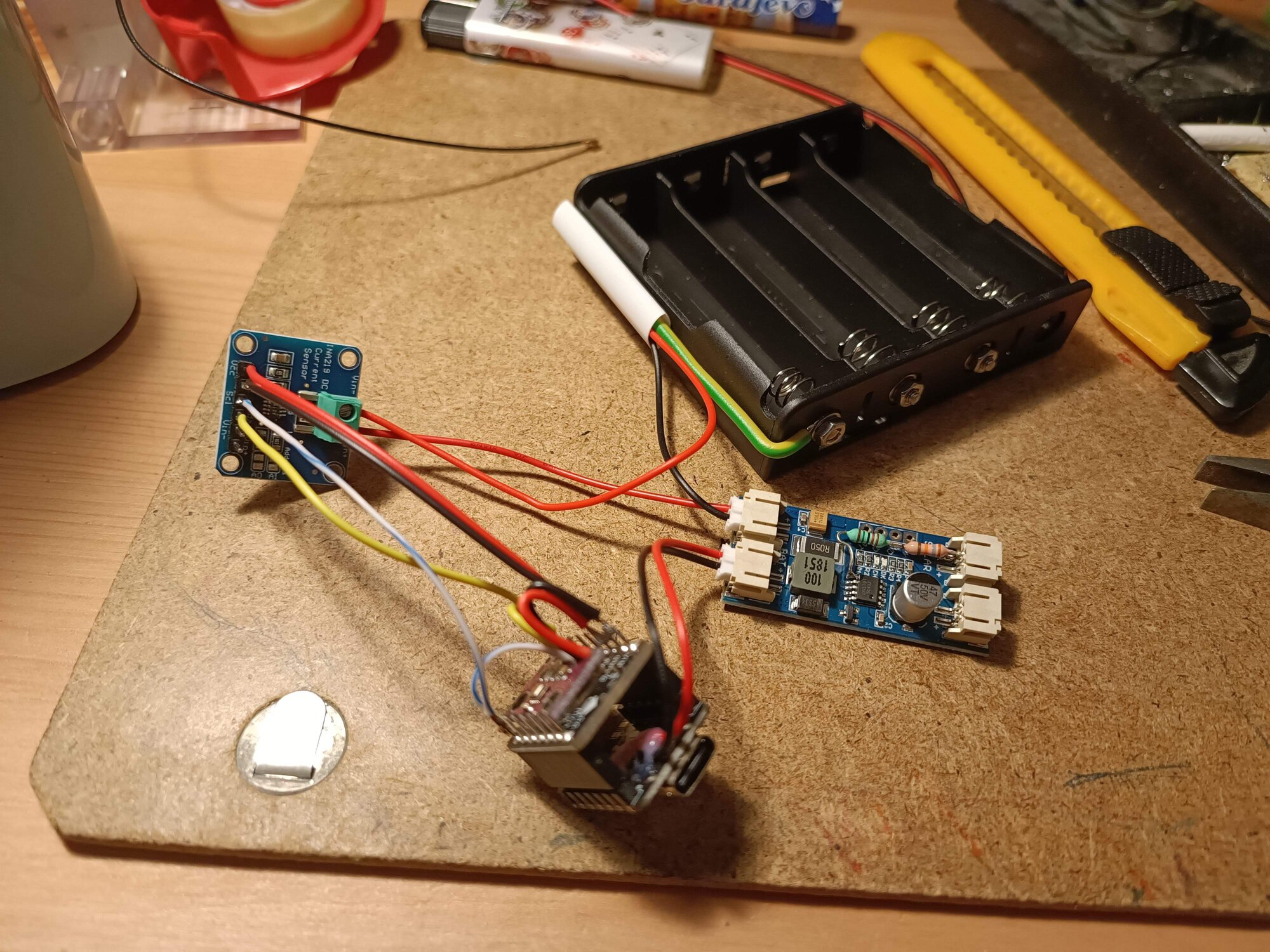
Is it charging at all?
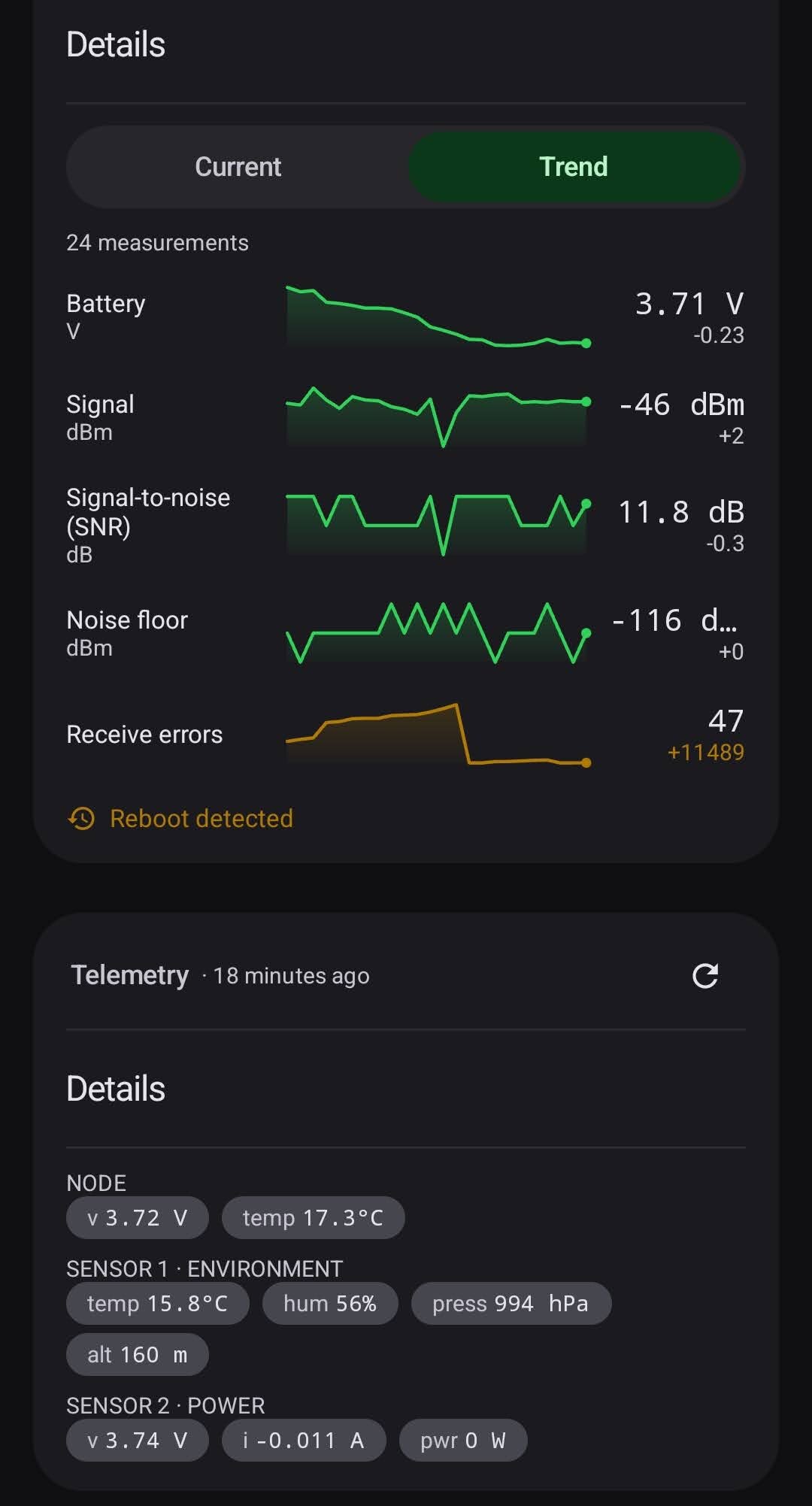
In the evening it read -10 mA, the next day -9, then -7 mA. I had expected a positive number. It was overcast and the repeater was still inside the room’s window, but the CN3791’s red LED was on. Until then that LED had been my only sign of charging, and I started to wonder whether reworking the MPPT divider had helped at all.
The multimeter showed about 16 V on the panel under load, with the battery at -10 mA. That is below the set operating point, where the CN3791 backs off the charge current, so at that moment practically nothing was coming from the sun. The red LED stays on anyway: the charger is in its charging state, the current is just zero.
A few minutes later it was 17.01 V under load and 18.75 V open circuit. So the charger holds the panel at about 17 V, a little below the calculated 17.45 V, which is within the parts’ tolerance. Since then I have also seen +50 mA of charge current.
The panel’s maximum power point moves down in weak light and in summer heat, so an operating point around 15 V may be the better compromise. The proper way to show what the reworked divider gains would be the panel’s current–voltage curve, with several dividers. I had no time for that yet, so it stays at 17 V for now.
The INA219’s own consumption
Between readings the INA219 drew 579 µA, which is a lot next to the -10 mA in the evening. ZephCore uses the chip in triggered mode, but it does not go to sleep after a conversion. The Zephyr driver has power management, but its suspend only turns the ADC off instead of powering the chip down, and that measured 579 µA too. In power-down mode it is 4 µA. I sent the fix to ZephCore as PR #115.
In the telemetry, sensor 2 is the INA219: 3.74 V and -11 mA. Power shows 0 W because the Cayenne LPP format carries it with 1 W resolution, and current only goes through in mA steps.
In a box
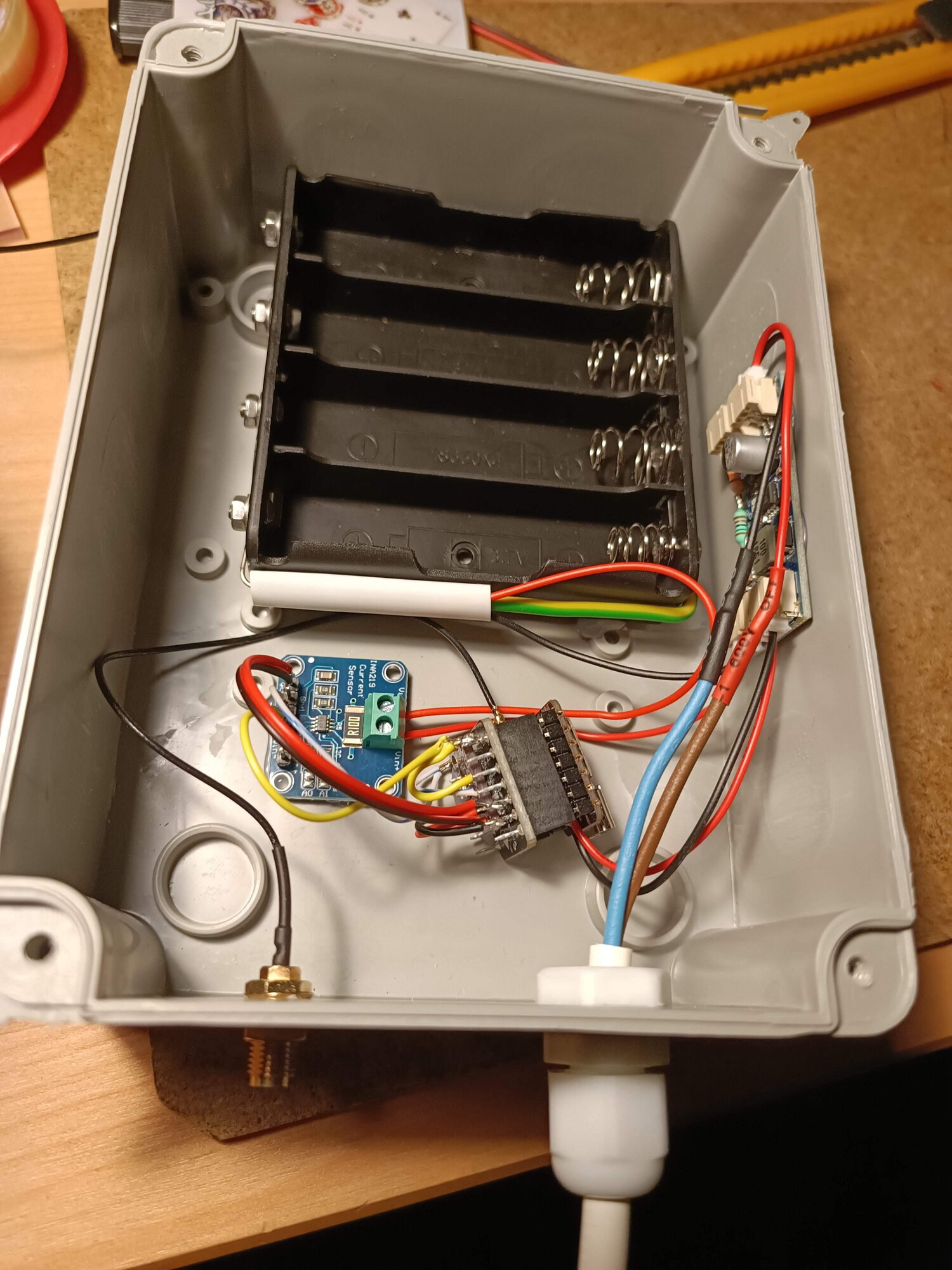
Meanwhile I boxed it up: the cell holder, the INA219, the XIAO and, on the side, the CN3791 went into a grey enclosure. The antenna leaves through an SMA connector, the cable through a gland.
It is now outside the window rather than inside. I hope nobody climbs up for it.
What’s next
Data. I want the telemetry in my Home Assistant at home, which needs a second XIAO running companion firmware, on USB to the RPi4 that runs Home Assistant. A second INA219 in the panel’s lead would be good too, to see directly what the panel delivers. After that comes the current–voltage curve with several dividers.